Choosing the Right Botanical Watercolor Clipart Orchid PNG for Professional Results
In the world of digital design, the difference between an amateur-looking project and a polished, professional piece often comes down to the quality of your assets. This is especially true when working with delicate subjects like florals. Many creators rush to download free or low-quality images, only to find that their final prints look pixelated or their digital layouts feel cluttered. Understanding the specific value of high-resolution Botanical Watercolor Clipart Orchid PNG files can save you hours of frustration and significantly elevate your creative output.
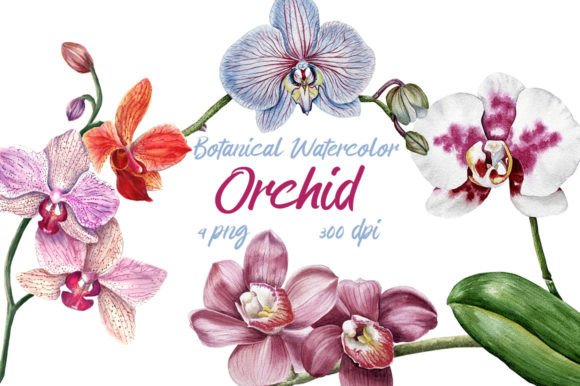
Orchids are a popular choice for invitations, branding, and home decor due to their elegance and complex structure. However, capturing that elegance digitally requires more than just a pretty picture. It requires technical precision. When you invest in a set of hand-painted elements, such as a collection featuring four distinct orchid designs saved individually in PNG format, you are buying flexibility and quality. But knowing how to use them correctly is just as important as owning them.
The Transparency Trap: Why Backgrounds Matter
One of the most common mistakes beginners make is overlooking the file format. You might find a beautiful orchid illustration, but if it comes as a JPEG with a white background, your workflow immediately becomes more difficult. Removing a white background from a watercolor image is notoriously tricky because watercolors rely on soft edges and varying opacity. A hard-edged cutout will look artificial and ruin the organic feel of the artwork.
This is why a transparent background is non-negotiable for serious design work. The Botanical Watercolor Clipart Orchid PNG format ensures that the delicate fades and splatters of the paint blend seamlessly into whatever background you choose. Whether you are placing the flower over a textured paper scan for a wedding invitation or overlaying it on a pastel gradient for a blog header, the transparency allows the image to breathe. Without it, you are left with awkward white boxes around your flowers, forcing you to spend valuable time using complex masking tools in software like Photoshop or Canva, often with inferior results.
Resolution Misconceptions: Screen vs. Print
Another frequent oversight involves resolution. Many creators assume that if an image looks good on their monitor, it will look good in print. This is a costly error. Screens typically display images at 72 DPI (dots per inch), which is sufficient for web use but terrible for printing. When you send a 72 DPI image to a printer, the result is often blurry, pixelated, and unprofessional.
High-quality clipart sets, such as those offering 300 DPI at substantial sizes like 9×12 inches, are designed to bridge this gap. At 300 DPI, the image contains enough data to render crisp details even when printed on physical materials. If you are creating physical scrapbooking pages, decoupage projects, or announcement cards, this resolution is essential. Before downloading any asset, always check the DPI. If it is not explicitly stated as 300 DPI, assume it is not suitable for high-quality printing. Using a low-resolution file for a client’s logo or a large-format poster can damage your reputation and require a complete redesign.
Color Space Confusion: RGB vs. CMYK
While less common for casual hobbyists, understanding color space is vital for professionals. Most digital clipart, including standard Botanical Watercolor Clipart Orchid PNG files, is provided in RGB (Red, Green, Blue) color mode. This is ideal for anything viewed on a screen, such as websites, social media posts, and digital planners. However, printers use CMYK (Cyan, Magenta, Yellow, Key/Black).
The mistake here is not necessarily buying RGB files, but failing to anticipate how colors might shift during printing. Watercolors often feature subtle purples and blues that can appear duller when converted to CMYK. To avoid disappointment, always print a test page on your home printer before sending a large job to a professional service. If you are designing for web-only use, RGB is perfect and will ensure your colors remain vibrant and true to the original hand-painted art.
Versatility and Application: Beyond the Obvious
Many users limit their clipart usage to simple document decoration. However, a versatile set of four individual orchid elements opens up a wide range of creative possibilities. Because each element is saved separately, you can mix and match them to create custom arrangements. This is particularly useful for:
- Planners and Journals: Use smaller scaled versions to decorate daily logs without overwhelming the text.
- Branding and Logos: Combine elements to create a unique floral emblem for beauty brands, wellness coaches, or boutiques.
- Digital Scrapbooking: Layer the PNGs over photos to add depth and artistic flair to memory keeping.
- Product Mockups: Overlay the orchids onto images of mugs, tote bags, or phone cases to visualize custom merchandise.
A common error is using the entire set as a single static image. By utilizing the individual files, you gain the ability to rotate, resize, and recolor each flower to fit your specific composition. This level of control transforms a simple clipart pack into a comprehensive design toolkit.
What to Check Before You Buy or Download
To ensure you are getting the best value and avoiding technical headaches, keep this checklist in mind when evaluating Botanical Watercolor Clipart Orchid PNG resources:
- File Format: Confirm the files are PNGs with transparent backgrounds. Avoid JPEGs unless you are prepared for extensive editing.
- Resolution: Look for 300 DPI. Check the pixel dimensions to ensure they are large enough for your intended use (e.g., 9×12 inches is excellent for most print projects).
- Licensing Terms: Read the license carefully. Can you use the images for commercial products? Do you need to provide attribution? Some licenses restrict use on print-on-demand sites, so verify this if you are an entrepreneur.
- Artistic Style Consistency: Ensure the watercolor style matches your brand aesthetic. Hand-painted elements should have natural imperfections and texture, not look like sterile vector graphics.
By paying attention to these details, you avoid the pitfall of downloading assets that look promising but fail to deliver in practical application. High-quality digital assets are an investment in your efficiency and the professionalism of your final product. Whether you are a freelancer designing for clients or a hobbyist creating heartfelt cards, choosing the right Botanical Watercolor Clipart Orchid PNG ensures your vision is realized with clarity and elegance.
Ultimately, the goal is to let the beauty of the orchid shine without technical distractions. When you start with high-resolution, transparent, and properly licensed files, you free yourself to focus on creativity rather than troubleshooting. Take the time to evaluate your resources, and your design process will become smoother, faster, and far more satisfying.